Madrid definitely has an eclectic mix of architecture, as I've already posted a few examples of (lizard and wedding cake buildings, most ostentatious belle epoque, and Herzog and de Meuron's masterpiece). You can really get a feel for the history of Spain, just by walking around and observing different architectural influences over the centuries. Unfortunately, few examples remain of the rich mudéjar style developed by the Moors that I lavished in on my trip to Andalucía. Some of the only reminders of the Muslim origins of Madrid are the remaining pieces of the Muralla Árabe (Arab Wall).
There are some fascinating and seemingly forgotten old buildings if you can find them, tucked away next to sober dictatorship-era construction. One of the sites that caught my imagination was this ancient construction, which has been converted into the Biblioteca Escuelas Pías (Pious school library). It's located in Lavapiés, the old Jewish barrio, where there are some sites related to Inquisition history that I will post about next.
And characteristic of Madrid, it's juxtaposed next to this odd urban plaza straight out of a post-Modern dream. By the way, this is not a great neighborhood and I wouldn't recommend walking around here at night, but this is a fascinating area with so much history and worthy of a daytime exploration.
Plaza de la Villa
The intimate Plaza de la Villa on Calle Mayor is one of Madrid's more notable example's of Madrid-style baroque architecture (barroco madrileño), with wonderfully preserved buildings on all three sides. This square was the permanent seat of the Madrid city government from the Middle Ages, until they relocated to the Palacio de Comunicaciones in recent years.
On the eastern side of the square is the 15th century Casa de los Lujanes, a Gothic construction with clear mudéjar influence. The brickwork tower is said to have housed the imprisoned French monarch
Francois I and his sons after the Battle of Pavia in 1525. As the
prisoner was paraded down Calle Mayor, it was said that locals were more
impressed with the lavishly attired Frenchman than his captor the
Spanish Habsburg emperor Carlos I.
This is the really cool and creepy door to the tower - it's on the northern side of the building as you curve around a tiny street that feeds into the plaza.
Is anyone as obsessed as I am with the Google street maps photos option? It lets you see different viewpoints, times, and seasons simultaneously in one place, and it even tries to match the perspective of the photo, creating a new three-dimensional plane for the various contributions. How cool.
Showing posts with label Madrid. Show all posts
Friday, April 27, 2012
Monday, April 23, 2012
Giant pink sheep in the Puerta de Alcalá

I think the only thing the Puerta de Alcalá is missing is a giant pink sheep. Here's why.
Around November 20th every year, shepherds bring their flocks of sheep directly through the center of Madrid, in between these two stone markers (mojones) on the eastern side of Plaza Alcalá. This is supposed to be quite a scene, and it's a tradition that dates back to 1273 during the time of King Alfonso X. Livestock owners founded an organization that was empowered with keeping open livestock paths throughout the country, enabling the sheep to move between the northern and southern provinces and avoid the cold weather.
The pathway marked at Puerta de Alcalá is one of the last of nine remaining in Spain. If you go to look for the mojones, they are really easy to miss. One is to the left of the entrance to Retiro Park, and the other is on the northeast corner of the Plaza de la Independencia.
All of the livestock paths were of varying width, but the widest at 75.23 meters are knows as cañadas reales (royal livestock passageways). The width between the two markers is ceremoniously measured by the shepherds each time they bring their flock into the city, reasserting their rights and confirming the path established 800 years ago.
So back to my giant pink sheep idea. We all need something that disconnects us from our everyday lives sometimes, and encourages us to see our surroundings in a new way. Madrid, as viewed through the arches of the puerta de Alcalá, soaring up the Gran Via, has an entirely different cadence with a giant pink sheep in the foreground. It allows city dwellers to break from reality and enter a bright, colorful fantasy city.
The installation creates its own narrative while at the same time uncovering an existing, forgotten one. Like the artworks I've posted on this blog, this intervention uses an existing viewpoint, and offers a way to experience the landscape with a point of comparison. The visual comparison is any aspect of the form: color, material, shape, angle, scale, etc. The possible material I could use reminds me of my beloved Breyer horses that I used to play with incessantly as a kid - impossibly smooth plastic.
The giant pink sheep would coincide with the actual running of the sheep in November and there would be at least one where the flock enters Madrid (above), and possibly others at different points along the trail.
Wednesday, April 18, 2012
Ornate street signs that I have to finally post about
I've been secretly wanting to post about the street signs in Madrid ever since I moved here. Each street in Madrid has a sign intricately painted on nine white tiles that commemorates its history, and some of the illustrations have dark stories to tell.
This one tells the story of a miracle, and you can read it here on my Cowbird page, or just keep reading.
This means "fist in the face street", and it's not because of a street fight long ago. Puñonrostro is actually someone's last name.
Sword Street, because there was a fencing school on this street and the owner always left a sword hanging in front of his house to advertise.
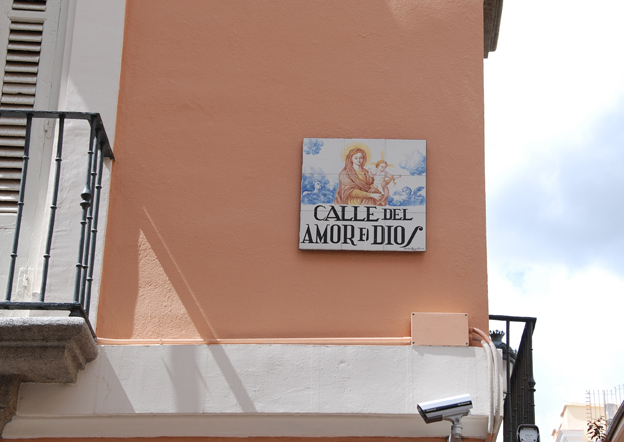
And lastly, our street! Calle del Amor de Dios. Looks like we've got double protection - from the gods and the surveillance cameras.
This one tells the story of a miracle, and you can read it here on my Cowbird page, or just keep reading.
Legend has it that a wealthy
priest once lived on this street, whose possessions were coveted by his
Portuguese servant. One night the servant killed the priest, cut off his
head, and ran off to Lisbon with all of the gold and valuables in the
house.
When the priest's body was discovered it
became the talk of Madrid, but since the servant had escaped, after
some time the crime was mostly forgotten.
Some years later however, the servant
returned to Madrid, now dressed in the guise of a prosperous gentleman.
He was walking through the Rastro one morning (the city's largest market
and slaughterhouse), not far from where the crime had been committed,
and decided to buy a calf's head for his dinner (a common dish in
Spanish villages at this time). After buying the calf's head, he placed
it under his cape and began to walk home.
A nearby watchman noticed blood dripping
from under the servant's cape, and stopped him to demand to know what
it was. "It is the calf's head I just bought at the market", he told
him. But the watchman was still suspicious and he asked to see it.
When the servant opened his cape, to
both of their astonishment and horror, it was the head of the priest
that he had murdered. The watchman immediately arrested him and brought
him to jail. In the trial that followed, the former servant was found
guilty and sentenced to be hanged in Plaza Mayor.
Once the execution had been carried out, the priest's head turned back into that of a calf.
This means "fist in the face street", and it's not because of a street fight long ago. Puñonrostro is actually someone's last name.
Sword Street, because there was a fencing school on this street and the owner always left a sword hanging in front of his house to advertise.
![]() |
| Calle de Jesus |
![]() |
| I love this one. |
![]() |
| This is the only pictogram street sign I've found so far! |
Ella: Geting closer
I just rediscovered this video that I created with Imovie last fall. I was taking various videos in my explorations around my new city of Madrid. I called it Ella after the fictional character in many of my creations, who may imbue many of my own characteristics.
Sunday, February 5, 2012
Fallen angels, gigantic monuments and an open-air sculpture museum
Madrid is home to the only statue in the world dedicated to Lucifer, the fallen angel who is believed to become the devil. It's well worth a detour to see, especially since it's in beautiful Retiro Park. Sculpted by Ricardo Bellver, a Madrid sculptor living in Rome in 1877, it caused a great deal of controversy when the Duke of Fernán Núñez purchased the statue to be placed in this popular crossroads in the Retiro. Especially to religious folks, it was unthinkable to have a monument dedicated to Lucifer in a public park, but the Duke explained that it was a work of incredible artistic workmanship and a metaphor of the fate that may arise for those who show excessive pride.
Possibly the most curious fact about this statue is that it's location is exactly 666 meters above sea level, interpreted by some as the number of the Anti-Christ.
The pedestal was designed by José Urioste with eight gargoyle-like heads spouting water, and the statue was unveiled in its current location in 1885, undoubtedly becoming the talk of the town.
Walking along Calle Mayor you will come into view of another fallen angel statue, but this one is called Accidente Aereo, a sculpture by Miguel Ángel Ruiz in 2006. In the artist's words: "Ni Ícaro, ni el diablo. Es un aviador distraído". He describes it as a Being who has flown around the Peninsula for thousands of years and when he unexpectedly comes into contact with the high-rises of Madrid he crashes into one of them.

Moving on to non-angel related sights, strolling up Calle Serrano just North of Puerta de Alcalá will bring you face to face with gigantic monuments dedicated to the discovery of America. This is Monumento de Descrubrimiento, erected in 1970, and is adjacent to Plaza de Colón (which has a great statue of Christopher Columbus in the center of the rotary) and the Archaeological Museum (still not open because of remodeling, but it's anticipated to be one of the best museums in Madrid once it opens it's doors again). Also, the garden next to the monument has the most gigantic Spanish flag on earth.

Walking just a little farther North on Calle Serrano will take you to a fascinating open-air sculpture museum, Museo de la Escultura Abstracta, located underneath the overpass of Paseo de Eduardo Dato. There are 17 abstract sculptures here including works by Joan Miró, Eduardo Chillida, and Alberto Sánchez. My favorite one is the giant concrete block suspended in mid-air by cables hanging from the bridge. It looks like it could have been made by the engineers of the bridge, with the same materials and pragmatism, so well integrated into the environment that it would be easy to walk right by it. But then there's that moment you realize, no wait, why would they have put that here? That's art.
Possibly the most curious fact about this statue is that it's location is exactly 666 meters above sea level, interpreted by some as the number of the Anti-Christ.
It depicts Lucifer as a winged youth being dragged to the netherworld by a large seven-headed serpent entwined around his legs. It was inspired by John Milton's poem Paradise Lost: "...his pride had cast him out from Heaven, with all his host of rebel angels... round he throws his baleful eyes that witnessed huge affliction and dismay mixed with obdurate pride and steadfast hate". The symbolism of the statue is complicated because the Romans believed that Lucifer carried the light that could save humanity even though he was bound to his destiny, and also the serpent that entwines him may represent wisdom.
The pedestal was designed by José Urioste with eight gargoyle-like heads spouting water, and the statue was unveiled in its current location in 1885, undoubtedly becoming the talk of the town.
Walking along Calle Mayor you will come into view of another fallen angel statue, but this one is called Accidente Aereo, a sculpture by Miguel Ángel Ruiz in 2006. In the artist's words: "Ni Ícaro, ni el diablo. Es un aviador distraído". He describes it as a Being who has flown around the Peninsula for thousands of years and when he unexpectedly comes into contact with the high-rises of Madrid he crashes into one of them.

Moving on to non-angel related sights, strolling up Calle Serrano just North of Puerta de Alcalá will bring you face to face with gigantic monuments dedicated to the discovery of America. This is Monumento de Descrubrimiento, erected in 1970, and is adjacent to Plaza de Colón (which has a great statue of Christopher Columbus in the center of the rotary) and the Archaeological Museum (still not open because of remodeling, but it's anticipated to be one of the best museums in Madrid once it opens it's doors again). Also, the garden next to the monument has the most gigantic Spanish flag on earth.

Walking just a little farther North on Calle Serrano will take you to a fascinating open-air sculpture museum, Museo de la Escultura Abstracta, located underneath the overpass of Paseo de Eduardo Dato. There are 17 abstract sculptures here including works by Joan Miró, Eduardo Chillida, and Alberto Sánchez. My favorite one is the giant concrete block suspended in mid-air by cables hanging from the bridge. It looks like it could have been made by the engineers of the bridge, with the same materials and pragmatism, so well integrated into the environment that it would be easy to walk right by it. But then there's that moment you realize, no wait, why would they have put that here? That's art.
![]() |
| Eduardo Chillida |
Labels:
discovery,
fallen angel,
Madrid,
madrid ocultos,
Miro,
monument
Wednesday, January 25, 2012
Sunday, January 8, 2012
More things you didn't know about Plaza Mayor
Plaza Mayor has a much darker past than you would imagine from the fun and festivities that fill the square these days. In the 17th and 18th Centuries it was the regular location for autos-de-fé, public condemnations for crimes against religion during the Inquisition. Prisoners sentenced to blasphemy, adultery, witchcraft and other crimes were burned, flogged, or banished to the underground labyrinth of prisons under the square.
Looking at the front of this Irish Pub off the Northeast corner of the plaza, you would have no idea that a former Inquisition-era torture chamber is just down the stairs inside.
We ventured down, as the Irish bartender explained that, yes, in fact this is where many prisoners were kept and tortured. He added that many were forced to eat the bodies of their dead companions if they didn't want to starve. Dean and I both noticed that the room felt really heavy, even with the jolly looking kegs of beer and new paint job. The bartender noted that they chose the color red for the new paint based on the secret history the room. Creepy.
Winding around to the Southwest corner of the square, there is a long and narrow set of stairs known as the Arco de Cuchilleros, leading down to Calle de los Cuchilleros or Knife-Grinders Street. The small pulpit that you can see in the photo above on the right is famous as the location where a friar gave a speech in 1808 to incite a citizen revolt against the occupying French.
As you wind down the stairs to the right is the well-known restaurant and tourist destination dedicated to a 19th century swindler.
In 19th century Madrid, there was an infamous bandit named Luis Candelas. He was known throughout Spain as a crafty gentleman and highway robber, who could steal anything and escape from anywhere. He was sensationalized in the press and romanticized in songs and films. Maybe it's this romantic view of robbery that encourages the ever-present Madrid pickpockets. Personally, I see nothing romantic about getting your stuff stolen. Anyways. The restaurant that's now near where he and his gang used to hang out is called Las Cuevas de Luis Candelas, and the waiters actually dress like bandits as well. Slightly unnerving, but the space is very interesting - a labyrinth of caves and cellars inside. The illustrations on the walls tell the tall tales of Candelas' adventures, and huge barrel vaulted ceilings and walls are covered with trinkets and memorabilia of the gentleman bandit's life of crime.
Walking down Calle Toledo just South of Plaza Mayor brings us to the Plaza de la Cebada, which became the regular location for public hangings and garrotings after 1790. Public executions were a popular source of entertainment for hundreds of years in Europe, with flocks of people surrounding the square and watching from the wooden tenements above. Maybe the modern equivalent is watching violence and murder on TV, so no need for public violence anymore? The fountain in the center of the rotary (above) is quite unusual - it used to provide drinking water to city residents.
To our left a tiny side street leads to the Plaza de Coscorro, with an interesting statue of a man carrying a box and torch with a rope tied around his chest. This is Eloy Gonzales, an orphan and jailbird who joined the Spanish fight in Cuba and offered himself in a suicide mission. The box contains gasoline, which he used to burn down the Cuban stronghold under the cover of night. He only agreed to do it if they would then drag his lifeless body back to the Spanish side out of enemy hands, in order to have a proper burial. He was seriously wounded but the Spaniards were able to drag him back to their side alive. He survived for only nine months after, dying as a result of his wounds just after receiving the medal of honor.
Just beyond the statue stretches a long, overwhelming sea of people and vendors selling what seems like mostly scarves and T-shirts. It's worth a visit if only to ogle at how many masses of people are there. This is El Rastro, Madrid's largest flea market. The name translates to "stain" or "trail of blood" because originally it was the site of a slaughterhouse in the 17th and 18th century. People would drag the animal carcasses down the street and the blood would stain the ground.
A nice discovery slightly off the beaten track is the small square, Plaza General Vara del Rey with very different types of vendors than the main drag. There are tables dedicated to rocks and minerals, and lots of antique decorative arts, lamps, chests and trinkets. Also in the area you can find vintage office equipment like typewriters and rolltop desks, and a telephone museum with gramophones and antique radios. There are also high quality antique galleries in indoor locations along the trail.
And these guys were a pretty random surprise, tucked into the square of a long-abandoned building in the La Latina neighborhood, very close to the flea market.
Looking at the front of this Irish Pub off the Northeast corner of the plaza, you would have no idea that a former Inquisition-era torture chamber is just down the stairs inside.
We ventured down, as the Irish bartender explained that, yes, in fact this is where many prisoners were kept and tortured. He added that many were forced to eat the bodies of their dead companions if they didn't want to starve. Dean and I both noticed that the room felt really heavy, even with the jolly looking kegs of beer and new paint job. The bartender noted that they chose the color red for the new paint based on the secret history the room. Creepy.
Winding around to the Southwest corner of the square, there is a long and narrow set of stairs known as the Arco de Cuchilleros, leading down to Calle de los Cuchilleros or Knife-Grinders Street. The small pulpit that you can see in the photo above on the right is famous as the location where a friar gave a speech in 1808 to incite a citizen revolt against the occupying French.
As you wind down the stairs to the right is the well-known restaurant and tourist destination dedicated to a 19th century swindler.
In 19th century Madrid, there was an infamous bandit named Luis Candelas. He was known throughout Spain as a crafty gentleman and highway robber, who could steal anything and escape from anywhere. He was sensationalized in the press and romanticized in songs and films. Maybe it's this romantic view of robbery that encourages the ever-present Madrid pickpockets. Personally, I see nothing romantic about getting your stuff stolen. Anyways. The restaurant that's now near where he and his gang used to hang out is called Las Cuevas de Luis Candelas, and the waiters actually dress like bandits as well. Slightly unnerving, but the space is very interesting - a labyrinth of caves and cellars inside. The illustrations on the walls tell the tall tales of Candelas' adventures, and huge barrel vaulted ceilings and walls are covered with trinkets and memorabilia of the gentleman bandit's life of crime.
Walking down Calle Toledo just South of Plaza Mayor brings us to the Plaza de la Cebada, which became the regular location for public hangings and garrotings after 1790. Public executions were a popular source of entertainment for hundreds of years in Europe, with flocks of people surrounding the square and watching from the wooden tenements above. Maybe the modern equivalent is watching violence and murder on TV, so no need for public violence anymore? The fountain in the center of the rotary (above) is quite unusual - it used to provide drinking water to city residents.
To our left a tiny side street leads to the Plaza de Coscorro, with an interesting statue of a man carrying a box and torch with a rope tied around his chest. This is Eloy Gonzales, an orphan and jailbird who joined the Spanish fight in Cuba and offered himself in a suicide mission. The box contains gasoline, which he used to burn down the Cuban stronghold under the cover of night. He only agreed to do it if they would then drag his lifeless body back to the Spanish side out of enemy hands, in order to have a proper burial. He was seriously wounded but the Spaniards were able to drag him back to their side alive. He survived for only nine months after, dying as a result of his wounds just after receiving the medal of honor.
Just beyond the statue stretches a long, overwhelming sea of people and vendors selling what seems like mostly scarves and T-shirts. It's worth a visit if only to ogle at how many masses of people are there. This is El Rastro, Madrid's largest flea market. The name translates to "stain" or "trail of blood" because originally it was the site of a slaughterhouse in the 17th and 18th century. People would drag the animal carcasses down the street and the blood would stain the ground.
A nice discovery slightly off the beaten track is the small square, Plaza General Vara del Rey with very different types of vendors than the main drag. There are tables dedicated to rocks and minerals, and lots of antique decorative arts, lamps, chests and trinkets. Also in the area you can find vintage office equipment like typewriters and rolltop desks, and a telephone museum with gramophones and antique radios. There are also high quality antique galleries in indoor locations along the trail.
And these guys were a pretty random surprise, tucked into the square of a long-abandoned building in the La Latina neighborhood, very close to the flea market.
Labels:
el rastro,
luis candelas,
Madrid,
madrid ocultos,
plaza mayor,
Spanish inquisition
Monday, January 2, 2012
Things you probably don't know about Plaza Mayor
Plaza Mayor is the busiest place in Madrid, maybe with the exception of Plaza del Sol. There are a million tourists, street performers, Spaniards with their children, and of course the ever present pick-pockets. I was overwhelmed by this area when we first visited because places like this remind me of Times Square in New York - there is so much visual stimulation, so many sounds, and so many crowds of people, that you can't understand anything else about the place. I prefer the quiet, off-the-beaten-track streets. Nonetheless, I was reading in my new favorite book about Plaza Mayor the other day, and decided to go on a historical tour.
First stop, however, was for a bocadillo de calamares. This is the spot to get them, except I heard that the best bocadillo de calamares can be found near the train station on Atocha. I'll have to check that out. Bar La Ideal is just outside the Plaza Mayor on the Southeast corner. It's the entrance that is closest to our house, thankfully, so I don't have to walk too far for my bocadillo. I should mention that in English it's a Fried Calamari sandwich. Yes, this is very normal in Madrid, to eat fried things on bread. One of my favorite things is fried calamari, and one of my other favorite things is bread, so I'm happy here.
![]() |
| This is what it looks like inside the joint. |
![]() |
| This is some other stuff they offer, clearly not on my list of things to try. |
There's an interesting story about the equestrian statue in the center of Plaza Mayor. It's a large cast-iron horse with Felipe III mounted on top, looking especially imposing with his sword and 17th century armor. But little do people know that the horse was actually a cemetery for dozens of sparrows who were "eaten" by the noble steed.
Now its mouth is soldered closed, but originally the horse's mouth was open just enough for a tiny bird to fly in. Once the bird perched on the mouth and then flew inside, they fluttered around in the dark bowels of the horse trying to find a way out but their wingspan was too wide to make it back out. And so sealed their fate. For hundreds of years, no one knew about the sparrow death trap, until the militant uprising in 1931 when a small bomb was thrown inside the horse's mouth and suddenly hundreds of bird bones filled the sky of Plaza Mayor.
Next on the tour is the narrowest house in Madrid, measuring 15 meters. It's not that narrow, actually, compared to some of the tenement housing in New York City, but still an interesting landmark. And the decorative lights on the street are beautiful.
The address is Calle Mayor 61, and it is the former home of the Spanish author Pedro Calderón de la Barca. I mentioned the town historian Ramón de Mesonero Romanos in a previous post, who tried to save Cervantes house from being torn down. Well, after that defeat, he wasn't going to take no for an answer this time. He was an old man by this time, and he literally went to the site of the house and physically blocked the demolition crew's sledge-hammers by swinging his cane at them. He kept guard until nighttime and then drafted a petition in the morning, which successfully halted the demolition and thus preserved the historical building.
Subscribe to:
Posts (Atom)